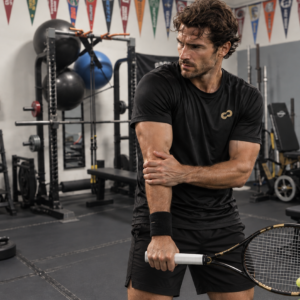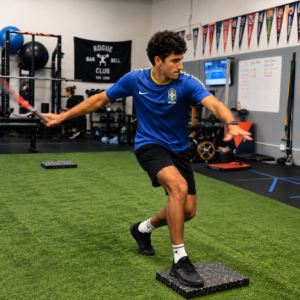
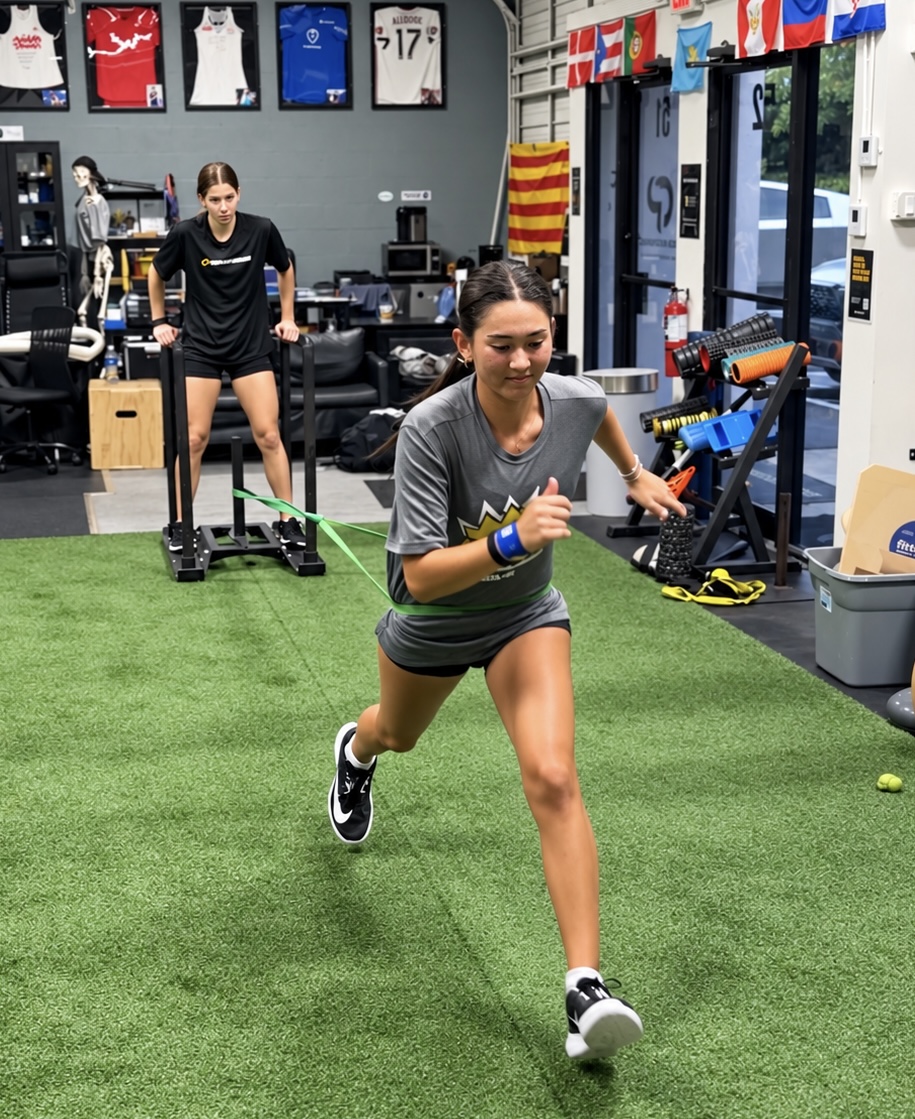
A tennis exercise doesn’t need to look like tennis to improve tennis performance.
This distinction is important.
We often see the idea of “sport-specific training” interpreted very literally. If the athlete plays tennis, exercises start to include rackets, tennis strokes, unstable surfaces or movements designed to visually resemble what happens on court.
But similarity doesn’t necessarily mean transfer.
The purpose of off-court tennis training is not to recreate tennis inside the gym.
It is to develop physical capacities that give the athlete more options when playing the sport.
What is off-court tennis training?
Off-court tennis training is the physical preparation that supports what the athlete needs to do on court.
This can include strength and conditioning, acceleration and deceleration, power development, mobility, coordination, reactive movement, recovery and physical assessment.
Tennis itself remains the most specific environment for developing tennis skills.
The role of physical preparation is different.
We want to improve the athlete’s ability to produce force, absorb force, move efficiently, tolerate physical demands and repeatedly express these qualities throughout training and competition.
That distinction changes the way we think about transfer.
Transfer is not about making exercises look like tennis
Imagine a tennis player performing a medicine ball rotational throw.
Visually, we could try to make the exercise look exactly like a forehand.
But that isn’t necessarily the objective.
The tennis coach already has a much better tool for developing the forehand: the forehand itself.
In the gym, we can focus on qualities that contribute to the athlete’s ability to produce force rapidly and coordinate force through the body.
The same applies to strength exercises.
A split squat doesn’t look like tennis.
A deadlift doesn’t look like tennis.
A jump doesn’t look like tennis.
But the physical qualities developed through these exercises can contribute to how an athlete accelerates, brakes, changes direction, produces power and tolerates repeated loading.
The question shouldn’t always be:
“Does this exercise look like tennis?”
A better question is:
“What physical quality are we developing, and how could this athlete use that capacity on court?”
Strength creates possibilities
Strength is one of the foundations of physical performance.
A stronger athlete potentially has a greater capacity to produce and absorb force.
But strength alone doesn’t guarantee better tennis performance.
The athlete still needs to learn how to use that capacity under different speeds, positions and situations.
This is where the progression from general strength toward movement and power becomes important.
We can think of it as a continuum.
Strength builds capacity.
Power develops the ability to express force quickly.
Movement training challenges the athlete to organize that capacity.
Reactive training adds information and decision-making.
Tennis integrates everything into the sport.
Each layer has a different role.
Trying to make every strength exercise “tennis-specific” can actually remove some of the qualities we are trying to develop.
The court is unpredictable
A gym is usually a relatively controlled environment.
Tennis isn’t.
Players rarely encounter exactly the same movement twice.
Ball speed changes. Direction changes. Court position changes. The opponent changes the problem. Fatigue changes how the athlete moves.
Sometimes the player has time to organize.
Sometimes they don’t.
This means transfer cannot depend only on reproducing one ideal movement pattern.
The athlete needs physical capacity and enough movement variability to solve different problems.
This is particularly important when we think about acceleration and deceleration.
We don’t simply want a player who can perform a perfect change-of-direction drill between two cones.
We want an athlete capable of controlling momentum and reorganizing the body when the situation is not predetermined.
Information changes movement
This is also why reactive training can become an important bridge between the gym and the court.
A predetermined drill challenges physical execution.
A reactive drill adds another component: information.
The athlete may need to recognize a visual stimulus, make a decision and then move.
Now we are beginning to connect physical capacity with perception and decision-making.
But even here, we shouldn’t pretend that a reaction drill in the gym is tennis.
It is simply another step in the progression.
Ultimately, the complexity of the sport belongs on the court.
Transfer depends on the athlete
There is another reason why one “tennis-specific program” cannot work for everyone.
Athletes have different needs.
One player may need more strength.
Another may already be strong but need to improve rate of force development.
Another may struggle to absorb force during aggressive deceleration.
A growing junior may temporarily experience changes in coordination.
A professional athlete during a tournament may not need development at all. The priority may be maintaining physical qualities while controlling fatigue and supporting recovery.
This is why assessment and observation matter.
The exercise is only one part of the decision.
The athlete, the objective and the context determine its value.
Off-court training should complement tennis, not compete with it
One of the biggest mistakes in physical preparation is forgetting that athletes also have to practice and compete.
More training isn’t automatically better training.
A physically demanding session may be appropriate during a development period and completely inappropriate 24 hours before an important match.
The goal of strength and conditioning is not to demonstrate how hard we can train an athlete.
It is to provide the right stimulus at the right moment.
Sometimes we build.
Sometimes we maintain.
Sometimes we recover.
All three can be part of performance training.
Building the athlete behind the tennis player
At Costa Performance in Boca Raton, this is how we approach off-court tennis strength and conditioning.
We aren’t trying to replace the tennis coach.
We aren’t trying to recreate the tennis court inside the gym.
We are trying to develop physical qualities that complement the technical and tactical work happening on court.
Strength.
Power.
Acceleration.
Deceleration.
Movement.
Mobility.
Reaction.
Physical capacity.
Then we progressively create opportunities for the athlete to use those qualities in more complex environments.
The final transfer belongs to the sport.
And perhaps this is the simplest way to understand our philosophy:
The goal of off-court training isn’t to make the gym look more like tennis.
It’s to make the athlete more prepared for tennis.
Related Tennis Performance Articles:
Tennis Strength & Conditioning: https://blog.costaperformance.com/tennis-strength-conditioning-what-tennis-players-really-need-off-the-court/
↓
Deceleration in Tennis: https://blog.costaperformance.com/why-deceleration-matters-in-tennis-performance/
↓
What Tennis Performance Training Really Means: https://blog.costaperformance.com/what-does-tennis-performance-training-really-mean/
↓
From Gym to Court: Transfer (this article)
Cassiano Costa, PhD
Sports Biomechanics & Tennis Performance
Costa Performance | Boca Raton, Florida