Daniel (a fictional character) could hit his backhand comfortably during the warm-up.
The first few rallies felt normal. His grip was relaxed, the ball was arriving at a predictable speed and his elbow produced only a mild awareness that he had learned to tolerate.
Then the score reached 4–4.
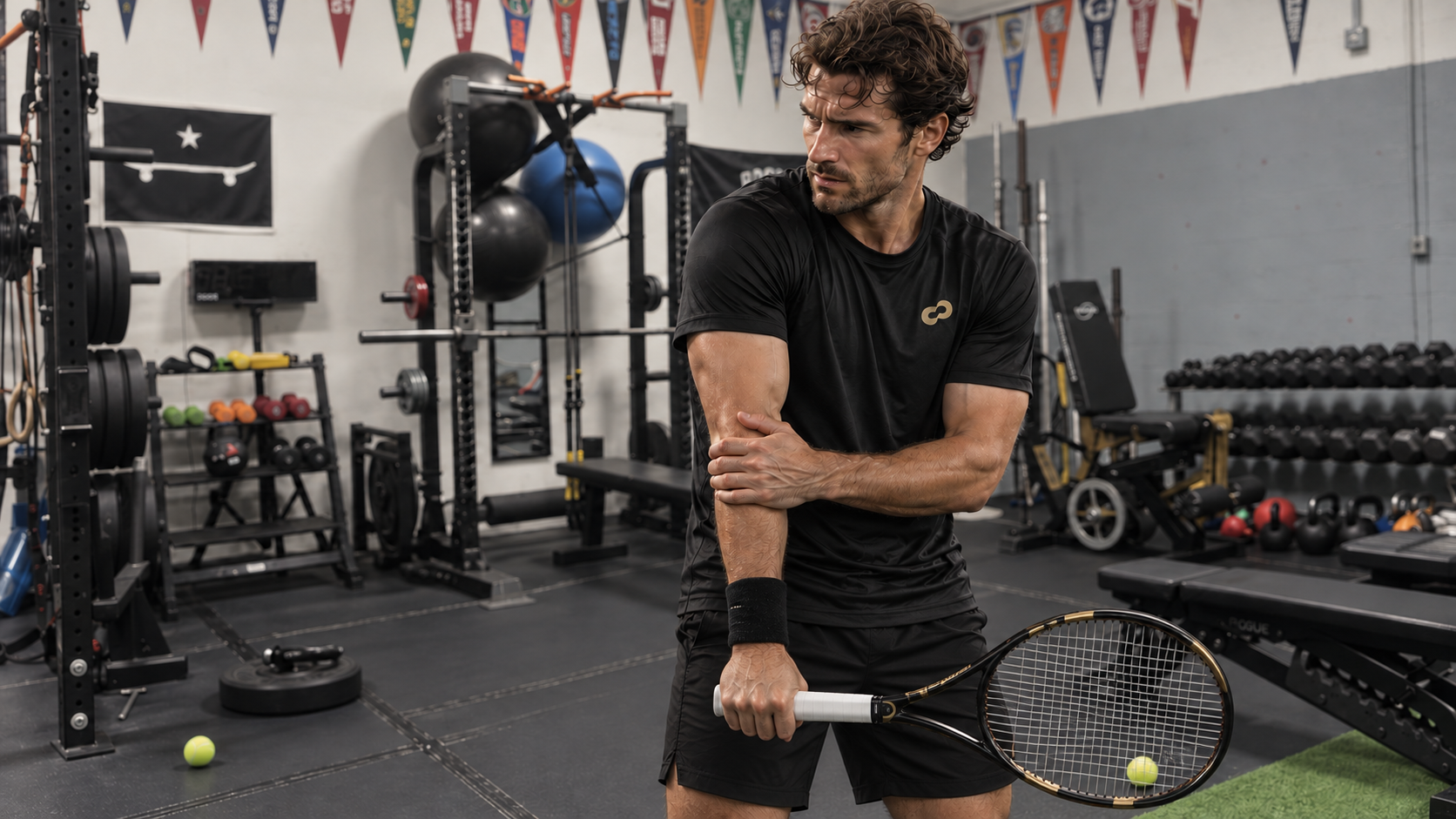
His opponent increased the pace and directed several balls toward Daniel’s backhand. Daniel tightened his grip, contacted the ball slightly late and felt a sharp pain on the outside of his elbow.
The next ball produced the same sensation. Before the third backhand even arrived, Daniel was already thinking about his elbow.
Soon, he was running around every possible backhand to play a forehand.
The elbow pain was real. But why did it become much stronger during an important game than during the warm-up?
The answer may involve both tendon capacity and the nervous system’s prediction of what is about to happen.
What is tennis elbow?
Tennis elbow is commonly used to describe pain around the lateral epicondyle, the bony area on the outside of the elbow. Clinically, it is often called lateral elbow tendinopathy or lateral epicondylalgia.
The common wrist-extensor tendon, particularly the region associated with the extensor carpi radialis brevis, is frequently involved. This muscle helps stabilize the wrist while the athlete grips the racket and transfers force into the ball.
Symptoms are commonly provoked by:
- Gripping the racket
- Resisted wrist extension
- Lifting with the palm facing downward
- Repeated backhands
- Late or off-center ball contact
- Sudden increases in tennis volume or intensity
The condition is not simply caused by poor technique, and it is not always purely inflammatory. Tendon structure, loading history, strength, recovery, equipment, technique and individual sensitivity can all contribute.
For Daniel, the problem began after he added an extra weekly match and changed to a firmer string setup. His elbow was exposed to more repeated gripping and ball-impact forces than it was prepared to tolerate.
That was the beginning of the problem, but it was not the complete story.
When pain becomes predictable
After several painful matches, Daniel’s nervous system began learning a pattern:
Fast ball to the backhand. Tight grip. Elbow pain.
The brain constantly uses previous experience to predict what is likely to happen next. This is known as predictive processing.
A previous expectation is called a prior. Current information from the body provides sensory evidence. The nervous system combines the two to interpret the situation and select an appropriate response.
By the time Daniel returned to competition, the backhand had become associated with threat. Seeing a fast ball approach that side of the court was enough to increase attention toward the elbow.
Normal sensations of muscular effort, tendon tension and racket vibration now carried greater significance. His grip became tighter, the arm became more rigid and the movement became less fluid.
The prediction and the movement strategy began reinforcing each other:
- Daniel expected the backhand to hurt.
- He increased his grip pressure and protected the arm.
- The rigid movement increased local demand and reduced confidence.
- Pain confirmed his original expectation.
- Avoiding the backhand prevented him from collecting evidence that the movement could become safe again.
This does not mean Daniel imagined the pain. His elbow had experienced a genuine period of excessive loading, and its capacity still required attention.
It means that the pain experience was now being influenced by both the condition of the tissue and what the nervous system had learned about the backhand.
Strength is necessary, but the story cannot end in the gym
Daniel’s rehabilitation initially focused on restoring physical capacity.
His program included progressive wrist-extensor loading, pain-free grip training and exercises for the shoulder, scapula and trunk. His tennis schedule was adjusted, and his racket setup and recent workload were reviewed.
After several weeks, his grip strength improved and resisted wrist extension became more comfortable. He could perform medicine-ball throws, cable rotations and demanding upper-body exercises without a meaningful increase in symptoms.
But matches still worried him.
This is where rehabilitation needed to progress from rebuilding the elbow to rebuilding trust in the backhand.
Creating new evidence on the court
The nervous system updates its predictions when reality repeatedly differs from what was expected. This difference is called a prediction error.
Daniel expected that a forceful backhand would cause sharp pain or further damage. To update that expectation, he needed credible experiences showing that he could perform the movement safely.
His progression looked like this:
- Shadow backhands with relaxed grip pressure
- Controlled racket swings with planned footwork
- Predictable hand-fed balls at moderate speed
- Cross-court backhand rallies
- Faster and less predictable feeds
- Backhands under physical fatigue
- Scored points with backhand-directed serves
- Competitive sets with normal tactical demands
The goal was not to force Daniel through severe pain. Each stage had to match his current physical capacity and produce an acceptable immediate and next-day response.
The most valuable experience was not a perfectly painless repetition. It was completing a meaningful tennis task without the feared consequence:
“I felt the elbow, but I played the point, maintained my technique and recovered normally.”
Repeated experiences like this can gradually reduce the precision assigned to the old prediction of danger.
Why match conditions matter
A tennis player can appear fully recovered during isolated drills but struggle when speed, uncertainty and score are introduced.
At 4–4, Daniel was processing much more than the mechanical load on his elbow:
- The importance of the point
- Uncertainty about the incoming ball
- Fear of another painful backhand
- Increased autonomic arousal
- Greater attention to elbow sensations
- The potential consequences of losing confidence
These factors can influence pain, grip pressure, coordination and defensive behavior. This is why return-to-play preparation should recreate the conditions in which the athlete actually needs to perform.
A successful gym test does not automatically mean that the athlete is ready for an unpredictable backhand at break point.
What coaches should communicate
Language can either support recovery or reinforce threat.
Constant reminders to “protect the elbow” may cause the player to monitor every sensation. Telling the athlete that the pain is only in the brain is equally unhelpful and inaccurate.
Better coaching language might include:
- “Your elbow has demonstrated more capacity than it had four weeks ago.”
- “Let’s keep the grip relaxed and allow the whole body to contribute.”
- “Some sensation does not automatically mean that you are causing damage.”
- “We will judge this session by your movement, performance and recovery.”
- “The goal is to build confidence under progressively realistic conditions.”
The athlete needs honest reassurance supported by measurable improvements, not empty promises.
Tennis elbow is rarely just one thing
Tennis elbow should not automatically be explained as a nervous-system problem. Persistent or worsening lateral elbow pain requires appropriate assessment because tendon pathology, joint conditions, cervical referral and nerve-related pain can produce overlapping symptoms.
Predictive processing is not a replacement for physical rehabilitation. It helps explain why symptoms can vary across environments and why restoring strength alone may not fully prepare an athlete for competition.
Daniel needed a stronger elbow. He also needed better load management, efficient footwork, improved force transfer and gradual exposure to the backhand he had learned to fear.
Eventually, another match reached 4–4.
His opponent attacked the backhand again. Daniel moved into position, allowed his legs and trunk to drive the shot and sent the ball deep across the court.
He noticed his elbow.
But this time, the sensation was no longer the end of the point.
It was simply information.
At Costa Performance, off-court tennis training is designed to connect strength, movement and physical capacity with the situations athletes actually face on court. Rehabilitation is not complete when an exercise becomes painless. It is complete when the athlete can trust the movement again under speed, fatigue, uncertainty and pressure.
Scientific references
- Lucado et al. Lateral Elbow Pain and Muscle Function Impairments: Clinical Practice Guidelines. JOSPT, 2022
- Coombes, Bisset and Vicenzino. A new integrative model of lateral epicondylalgia. British Journal of Sports Medicine, 2009
- Geuter et al. Functional dissociation of stimulus-intensity encoding and predictive coding of pain in the insula. eLife, 2017