When we talk about speed in tennis, the conversation usually focuses on how quickly a player can get to the ball.
But there is another part of movement that deserves just as much attention:
How well can the player stop?
Tennis is a sport of repeated accelerations, decelerations and changes of direction. A player may have only a few steps to reach the ball, but arriving there is only part of the task. They also need to control their body, establish an effective position to hit, and then reorganize quickly for the next movement.
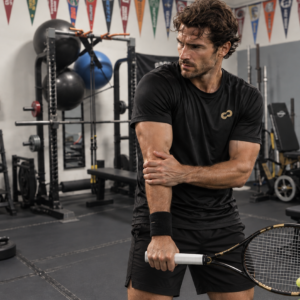
This is why, at Costa Performance, we consider deceleration an important component of physical preparation for tennis players.
Getting to the ball is only half of the movement
Imagine a player moving quickly toward a wide forehand.
Acceleration allows the athlete to reach the ball.
But as the player approaches the hitting position, the body has to manage the momentum that was just created.
The lower extremities need to absorb force. The center of mass needs to be controlled. The athlete needs to organize the trunk and lower body for the stroke while already preparing for what happens next.
If the athlete arrives quickly but needs additional steps to regain control, some of the advantage created by speed can disappear.
In tennis, therefore, movement efficiency is not simply about reaching high velocities.
It is about accelerating, controlling that velocity and being able to produce force again.
Deceleration is a strength quality
Stopping is not passive.
When a tennis player reduces velocity, the muscles of the lower extremities must produce force to absorb and control the body’s momentum.
This places significant demands on the ankle, knee and hip and requires eccentric strength, coordination and appropriate positioning.
For this reason, developing strength in the gym and developing movement on the court or training floor should not be viewed as completely separate processes.
General strength gives us physical capacity.
Movement training teaches the athlete how to access and organize that capacity in different situations.
The two need to communicate.
Tennis does not provide perfect positions
Traditional strength exercises are valuable because they allow us to progressively develop force in relatively controlled environments.
Tennis, however, is not controlled.
Players brake from different speeds, directions and body positions. Sometimes they have plenty of time to organize themselves. Sometimes they do not.
The ball, opponent and tactical situation continuously change the movement problem.
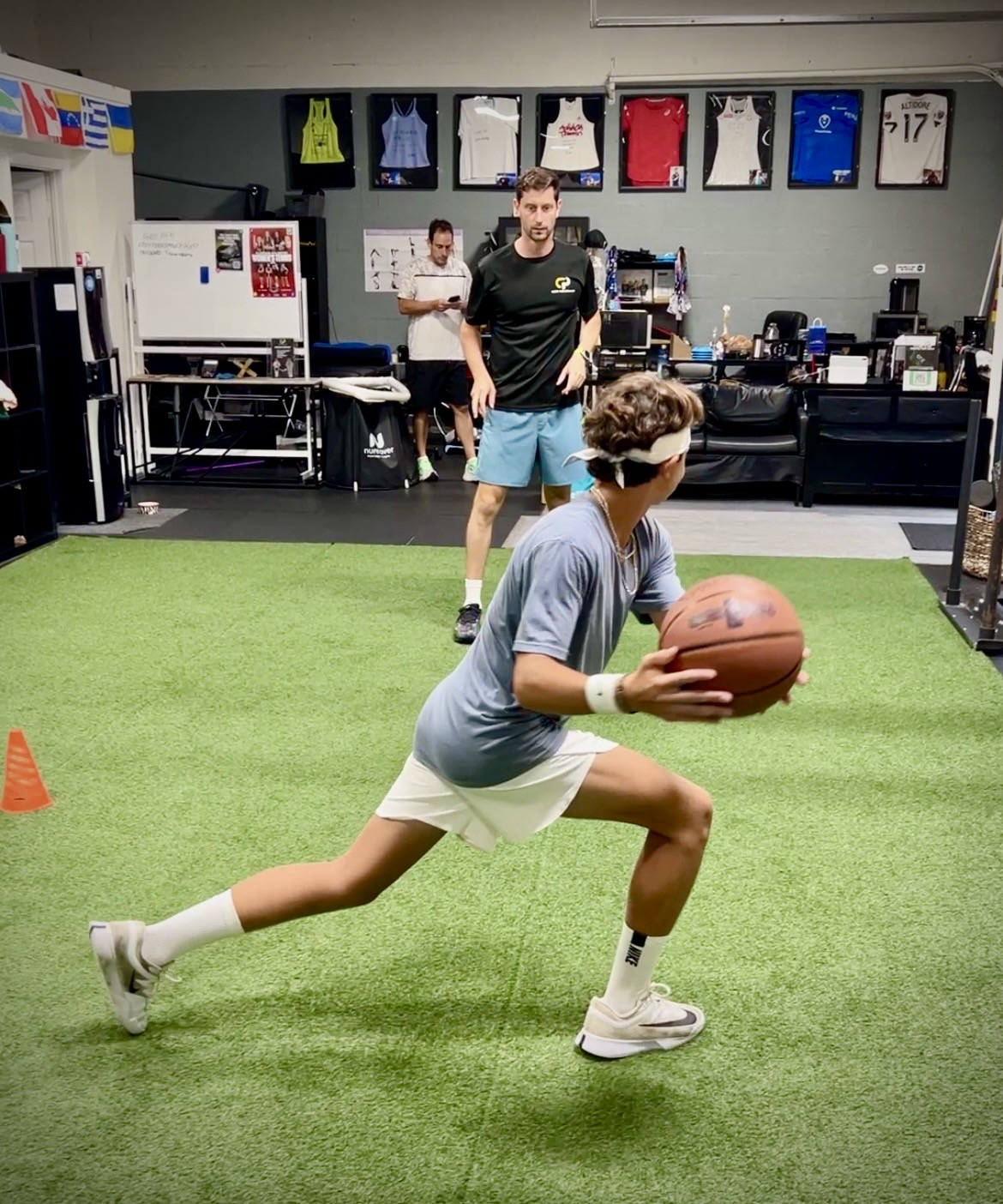
This means that physical preparation should eventually expose athletes to different deceleration strategies rather than trying to create one universally “correct” stopping technique.
A lateral movement may require one strategy. Moving forward toward a short ball may require another. Recovering after being pushed wide may create an entirely different mechanical problem.
The goal is to develop an athlete who can adapt.
Why footwork training needs to progress beyond predetermined drills
Cones and agility ladders can have a place in training.
They allow coaches to introduce movement patterns, coordination and rhythm in a controlled environment.
But there is an important limitation:
the athlete already knows where they are going.
Tennis does not work that way.
During a point, movement is driven by information: the opponent’s position, the direction and velocity of the ball, court position and tactical decisions.
As athletes develop, some movement training should therefore progress from predetermined drills toward tasks that require perception and reaction.
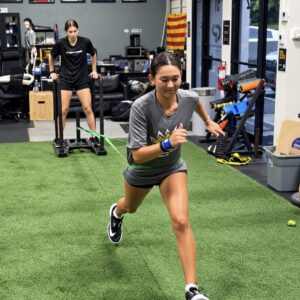
At Costa Performance, we can combine physical movement with visual or external stimuli so the athlete has to recognize information, make a decision, accelerate and then control the resulting movement.
We are not simply training faster feet.
We are training the relationship between perception, decision and movement.
Deceleration and injury risk
It is tempting to describe a particular exercise as an “injury prevention exercise.”
Human movement is more complicated than that.
Injuries are influenced by multiple factors, including previous injury, training load, fatigue, strength, recovery, competition schedule and the athlete’s individual characteristics.
Deceleration training cannot guarantee that an athlete will remain injury-free.
What it can do is help develop the physical capacity required to repeatedly absorb and redirect forces.
Instead of thinking only about preventing injury, we prefer to think about increasing the athlete’s capacity to tolerate the demands of tennis.
Junior tennis players need to learn how to control speed
This is particularly important in developing athletes.
Young players often become faster and more powerful as they grow, but increases in body size, limb length and strength do not always occur at exactly the same rate as coordination develops.
During periods of rapid growth, movement may temporarily feel different.
Physical preparation can provide an environment where junior athletes progressively explore acceleration, braking, balance, force production and different movement solutions.
The objective is not simply to make a 13-year-old move faster today.
It is to develop movement capabilities that can continue evolving as the athlete matures.
From the gym back to the court
Ultimately, deceleration training is not about creating athletes who are good at deceleration drills.
It is about improving their ability to solve movement problems during tennis.
Strength gives the athlete more capacity to produce and absorb force.
Movement training provides opportunities to use that capacity.
Reactive training adds information and decision-making.
And tennis provides the environment where all of those qualities ultimately need to work together.
That is why physical preparation should never try to replace tennis practice.
It should give the athlete more physical options to use when the game demands them.
At Costa Performance in Boca Raton, this relationship between strength, movement, reaction and sport is central to how we approach tennis performance training.
Because moving faster is important.
But being able to control that speed, and be ready for the next ball, may be just as important.
Cassiano Costa, PhD
Costa Performance
Boca Raton, Florida
Related articles:
Tennis Strength & Conditioning: https://blog.costaperformance.com/tennis-strength-conditioning-what-tennis-players-really-need-off-the-court/
↓
Deceleration in Tennis: https://blog.costaperformance.com/why-deceleration-matters-in-tennis-performance/
↓
What Tennis Performance Training Really Means: https://blog.costaperformance.com/what-does-tennis-performance-training-really-mean/
↓
From Gym to Court: Transfer: https://blog.costaperformance.com/from-gym-to-court-how-strength-conditioning-transfers-to-tennis-performance/