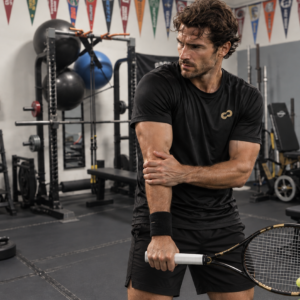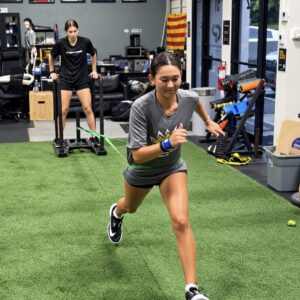
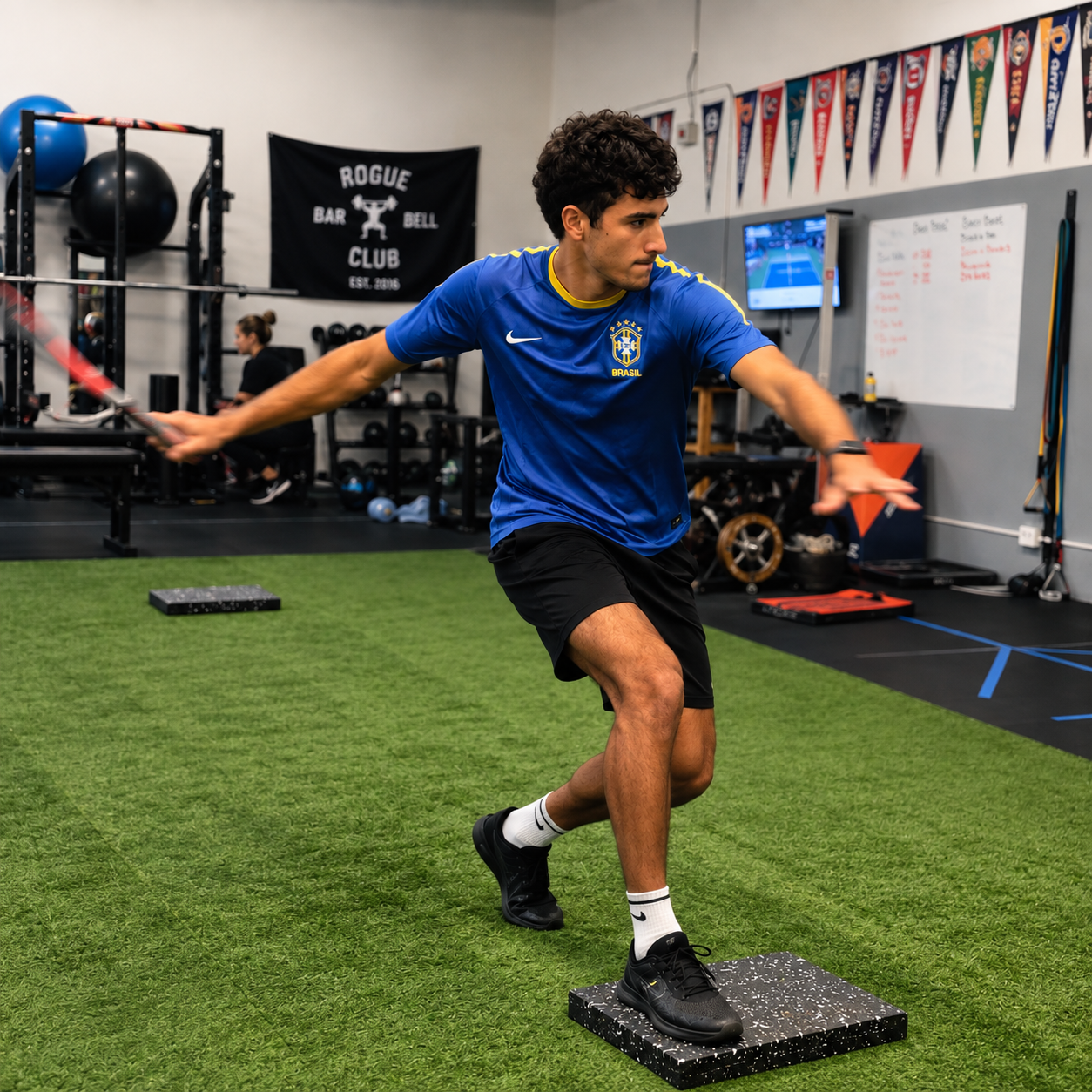
When people hear the term “tennis training,” the first image that usually comes to mind is a tennis court.
Forehands, backhands, serves, footwork and hours of practice with a racket.
But there is another part of developing a tennis player that happens away from the court.
Physical preparation.
At Costa Performance in Boca Raton, we work with tennis players of different ages and competitive levels, and one of the most important ideas behind our approach is simple:
The goal of physical preparation is not to teach tennis. It is to build an athlete who is physically better prepared to play tennis.
So, what does tennis performance training actually involve?
Tennis requires much more than strength
Strength is an important foundation for athletic development, but tennis presents a much broader physical problem.
During a point, players repeatedly accelerate, decelerate, change direction, rotate, react and produce force from different positions.
They need to move laterally, forward and backward. They need to control their bodies when reaching for difficult balls and then reorganize quickly for the next shot.
These actions happen repeatedly throughout practices and matches that can last for hours.
For that reason, a tennis performance program cannot be reduced to a traditional gym routine.
We need to develop physical qualities that help the athlete deal with the demands of the game.
Strength creates capacity
Strength training provides the athlete with a foundation to produce and absorb force.
Squats, lunges, deadlifts, pushes, pulls and other traditional exercises can all have a place in tennis preparation.
But the exercise itself is not what makes the training specific to tennis.
The decisions around the exercise do.
Which athlete are we training?
What does that athlete need?
Where are they in their development?
What is happening with their tournament schedule?
What physical qualities are limiting them?
A junior player going through a growth spurt may need something very different from an experienced professional during a tournament period.
The program needs to reflect that.
Speed also means being able to stop
Getting to the ball quickly is important.
But tennis movement does not end when the player reaches the ball.
The athlete needs to control the momentum created during acceleration, establish an effective position, hit and prepare for the next movement.
This makes deceleration an essential part of tennis performance.
Developing the ability to absorb force, control the center of mass and efficiently change direction can improve how athletes solve movement problems on court.
We therefore train acceleration and speed, but we also spend considerable time developing the ability to brake, control and move again.
Power needs to transfer through the body
Tennis strokes involve rotation, but rotational power is not simply about rotating the trunk.
Force production involves interaction with the ground and coordination between the lower extremities, pelvis, trunk and upper body.
Strength provides part of this capacity.
Power training teaches athletes to express force rapidly.
Exercises such as jumps, throws and medicine-ball variations can help develop this quality without trying to perfectly reproduce a forehand, backhand or serve inside the gym.
That distinction is important.
We don’t need to imitate tennis with weights.
We need to develop physical qualities that the athlete can take back to the court.
Movement needs information
Many traditional agility drills are predetermined.
The athlete knows where to move before the drill begins.
Tennis is different.
Movement happens in response to information.
Players are constantly interpreting the ball, their opponent, their position on the court and the tactical situation.
This is why movement training can progressively incorporate reactive components.
Visual cues, external stimuli and decision-making tasks allow us to combine physical qualities with perception and reaction.
The goal is not simply faster feet.
It is an athlete who can perceive, decide and move efficiently.
Mobility needs strength and control
Mobility is another important component of tennis performance.
The ankle, hip, thoracic spine and shoulder complex all need sufficient movement to accommodate the positions athletes encounter during the game.
But having more range of motion is not always the goal.
Athletes also need the strength and control to use that range.
For this reason, mobility should not exist as an isolated part of the program.
We want athletes who can access the positions they need and still produce or absorb force effectively within those positions.
Assessment helps us individualize the process
Two tennis players can have similar rankings and completely different physical profiles.
One athlete may need more lower-body strength.
Another may produce plenty of force but struggle to control deceleration.
Another may demonstrate limitations in mobility.
Another may have difficulty maintaining physical qualities during periods of high tournament load.
This is why assessment matters.
At Costa Performance, we combine coaching observation with objective performance testing when appropriate. Technologies such as force plates, hamstring strength testing and other assessment tools can provide additional information about how an athlete produces and absorbs force.
Technology does not make the decisions for us.
It helps us ask better questions.
Junior tennis players are developing athletes
Working with junior players requires an additional perspective.
Young tennis players are simultaneously learning the sport, developing physically and going through growth and maturation.
Their bodies can change significantly within relatively short periods.
Coordination may temporarily change during rapid growth. Training loads that were previously tolerated may suddenly become more challenging. Strength and mobility can develop at different rates.
Physical preparation therefore needs to consider more than immediate performance.
Our objective is to progressively build strength, coordination, movement variability, power and physical capacity that can support the athlete for years.
A successful junior program should help develop the athlete, not simply prepare the player for the next tournament.
Injury prevention is about building capacity
There is no exercise that can guarantee an athlete will not get injured.
Injury risk is influenced by previous injuries, training load, fatigue, recovery, strength, growth, competition schedule and many other factors.
Instead of promising to “prevent injuries,” our approach is to increase the athlete’s ability to tolerate the physical demands of tennis.
For one player, that may involve increasing lower-body strength.
For another, shoulder capacity.
For another, improving deceleration.
Sometimes the most important intervention may simply be recognizing that the athlete needs recovery rather than another difficult training session.
Good performance training is not always about doing more.
Sometimes it is about making a better decision.
Training needs to change during the season
Tennis presents another challenge that makes physical preparation particularly interesting.
The competitive calendar can be long and unpredictable.
Training during a development block is very different from training between tournaments.
And training during a Grand Slam or another major competition may be completely different again.
The objective of physical preparation changes with the context.
Sometimes we are trying to develop new physical qualities.
Sometimes we are trying to maintain them.
Sometimes the priority is recovery and making sure the athlete is ready to compete again.
This requires communication between the athlete, tennis coach and performance team.
A training program should be a plan.
It should never become a prison.
From junior development to professional tennis
The principles behind physical preparation remain similar across competitive levels, but how we apply them changes.
At Costa Performance in Boca Raton, our experience ranges from developing junior athletes to supporting professional tennis players during training and competition.
The equipment may become more sophisticated.
The measurements may become more detailed.
The training loads may change.
But the central question remains the same:
What does this athlete need today to become better prepared for the demands of tennis?
That question matters more than any individual exercise.
Because tennis performance training is not about creating the most impressive workout.
It is about combining strength, movement, power, reaction, mobility, assessment and recovery into a process that makes sense for the individual athlete.
The gym is not where tennis performance ends.
It is where we develop some of the physical tools the athlete will eventually need to express on the court.
And ultimately, that is the goal:
Not simply to build stronger tennis players, but to build more capable athletes who play tennis.
⸻
Cassiano Costa, PhD
Costa Performance
Boca Raton, Florida
Related articles:
Tennis Strength & Conditioning: https://blog.costaperformance.com/tennis-strength-conditioning-what-tennis-players-really-need-off-the-court/
↓
Deceleration in Tennis: https://blog.costaperformance.com/why-deceleration-matters-in-tennis-performance/
↓
What Tennis Performance Training Really Means: https://blog.costaperformance.com/what-does-tennis-performance-training-really-mean/
↓
From Gym to Court: Transfer: https://blog.costaperformance.com/from-gym-to-court-how-strength-conditioning-transfers-to-tennis-performance/