
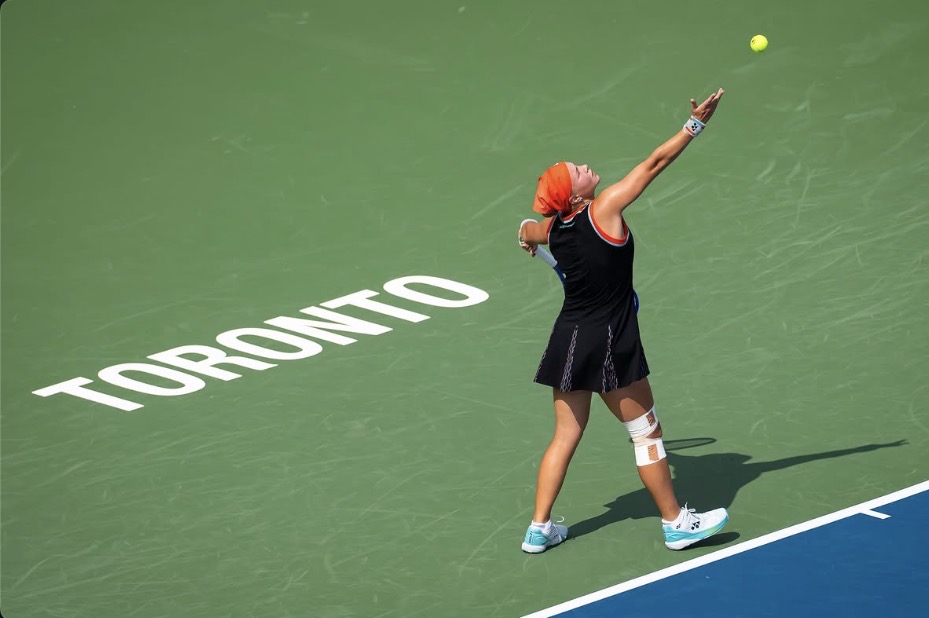
Tennis is a complex sport.
A player needs to accelerate, stop, change direction, rotate, react, produce force and recover, often within just a few seconds. Then they need to repeat these actions hundreds of times throughout a match while maintaining technical precision and decision-making.
This is why preparing a tennis player off the court should never simply mean getting stronger in the gym.
Strength matters, of course. But the real question is: strong for what?
At Costa Performance, this is one of the principles that guides our work with tennis players. Physical preparation should help the athlete become more capable of dealing with the specific demands of the sport, while building a body that can tolerate those demands repeatedly over a long season.
Strength is the foundation, not the final goal
Every athlete benefits from developing strength.
For tennis players, however, strength needs to support movements that are predominantly unilateral, multidirectional and highly variable.
A tennis player rarely produces force from a perfectly symmetrical position. The athlete is constantly transferring force from the ground through the legs, trunk and upper body while adapting to different ball positions, speeds and tactical situations.
This means that a good strength program should develop general force-producing capacity while also exposing the athlete to different positions, directions and movement strategies.
Squats, deadlifts, lunges, pushes, pulls and other traditional exercises can absolutely be part of the program.
But they are tools.
They are not the program itself.
The ability to stop may be as important as the ability to accelerate
Speed training often gets associated with running faster.
In tennis, acceleration is certainly important, but deceleration is equally critical.
Players repeatedly accelerate toward the ball and then need to absorb force, control their center of mass, reorganize their body and produce force again in another direction.
That requires eccentric strength, coordination and good control of the lower extremities.
An athlete who can accelerate quickly but cannot efficiently control that speed may lose time before the next movement, and may also expose the body to unnecessary mechanical stress.
For this reason, we spend considerable time teaching athletes not only how to move fast, but how to stop well.
Rotational power is more than rotating the trunk
Rotation is an obvious component of tennis, but powerful strokes are not produced by the trunk alone.
Force begins with interaction with the ground and travels through a kinetic chain involving the lower extremities, pelvis, trunk, shoulder and arm.
This is why rotational training should not simply consist of performing endless trunk rotations.
We need to develop the athlete’s ability to generate force from the ground, transfer it efficiently through the body and express it rapidly in movements that have some relationship with the demands of the sport.
Medicine-ball exercises are particularly useful here because they allow athletes to produce high levels of intent and velocity without requiring the movement to perfectly reproduce a forehand, backhand or serve.
The goal of physical preparation is not to recreate tennis in the gym.
The goal is to develop physical capacities that the athlete can use on the court.
Footwork is not just an agility ladder
Tennis movement is reactive.
The player does not know exactly where the next ball will go, how fast it will arrive or what position they will need to recover to afterward.
That makes tennis very different from performing predetermined patterns through cones or an agility ladder.
Those drills can sometimes be useful for coordination or warm-up purposes, but eventually physical preparation needs to include perception, reaction, decision-making and different movement solutions.
We work on acceleration, lateral movement, crossover steps, braking, repositioning and the ability to produce force from less-than-perfect positions.
The objective is not to create one “perfect” movement pattern.
It is to give the athlete more movement options.
Mobility and stability need to work together
Tennis requires substantial movement through the ankle, hip, thoracic spine and shoulder complex.
But more mobility is not automatically better.
An athlete needs enough range of motion to access the positions required by the sport, combined with enough strength and control to manage those positions.
This is why mobility work should not be separated from strength and movement training.
If an athlete gains range of motion but cannot produce or absorb force within that range, the additional mobility may have limited value for performance.
Our objective is therefore not simply to make athletes more flexible.
It is to make them strong and adaptable throughout the ranges they need to use.
Testing helps us understand the athlete in front of us
Two tennis players of the same age and competitive level can have completely different physical profiles.
One may have excellent lower-body power but poor eccentric strength. Another may demonstrate significant asymmetries. Another may have good strength but limited ankle mobility or difficulty controlling deceleration.
This is why assessment is an important part of the process.
At Costa Performance, we combine coaching observation with objective measurements when appropriate, using technologies such as force plates, NordBord testing and other performance assessment tools.
The numbers do not replace the coach.
They provide additional information that helps us make better decisions.
More importantly, testing allows us to follow changes over time instead of relying exclusively on subjective impressions.
Junior players require a long-term perspective
This becomes even more important when working with young tennis players.
Junior athletes are not simply smaller adults.
Growth, maturation, training history and tournament schedules all influence what an athlete needs at a particular moment.
During periods of rapid growth, coordination may temporarily change. Training loads that were previously well tolerated may suddenly become more challenging. Strength, mobility and movement quality can evolve at different rates.
For this reason, junior physical preparation should not be driven only by immediate performance.
We are trying to build an athlete who can continue developing for years.
That means progressively developing strength, coordination, movement variability, power and physical resilience without unnecessarily specializing every exercise around tennis.
Injury prevention is not a separate exercise
There is no single exercise that prevents tennis injuries.
Injury risk is influenced by many factors: training load, previous injury, strength, fatigue, recovery, growth, tournament scheduling and the demands placed on the athlete.
Good physical preparation contributes by increasing the athlete’s capacity to tolerate those demands.
That may mean improving calf strength for one athlete, shoulder capacity for another, eccentric lower-body strength for another, or simply managing training volume more intelligently during a heavy tournament period.
This is why we prefer to think about building capacity rather than performing an “injury prevention routine.”
The gym should prepare the athlete for the court, not compete with it
Ultimately, the best strength and conditioning program is not the one with the most sophisticated exercises.
It is the one that understands the athlete, the sport and the moment of the season.
A tennis player needs strength.
But also speed, braking ability, power, coordination, mobility, stability, endurance and the ability to repeatedly express those qualities under fatigue.
Our job off the court is to develop those capacities without forgetting what matters most:
the athlete still needs to play tennis.
Physical preparation should support technical development, tournament performance and long-term athletic development, not become another source of unnecessary fatigue.
That is the philosophy behind our work with tennis players at Costa Performance in Boca Raton.
We don’t train athletes simply to perform better exercises in the gym.
We train them to become more capable athletes when they step back onto the court.
Cassiano Costa, PhD
Costa Performance
Boca Raton, Florida
Related articles:
Tennis Strength & Conditioning: https://blog.costaperformance.com/tennis-strength-conditioning-what-tennis-players-really-need-off-the-court/
↓
Deceleration in Tennis: https://blog.costaperformance.com/why-deceleration-matters-in-tennis-performance/
↓
What Tennis Performance Training Really Means: https://blog.costaperformance.com/what-does-tennis-performance-training-really-mean/
↓
From Gym to Court: Transfer: https://blog.costaperformance.com/from-gym-to-court-how-strength-conditioning-transfers-to-tennis-performance/
Amazing article! Helpful and inspiring