How objective testing helped guide two months of targeted physical preparation at Costa Performance.
Performance testing becomes valuable when it changes what we do next.
This case study with tennis player Harlow Pieramici is a good example of how communication between the tennis coach, athlete and performance team can turn a question from the court into a more focused off-court training strategy.
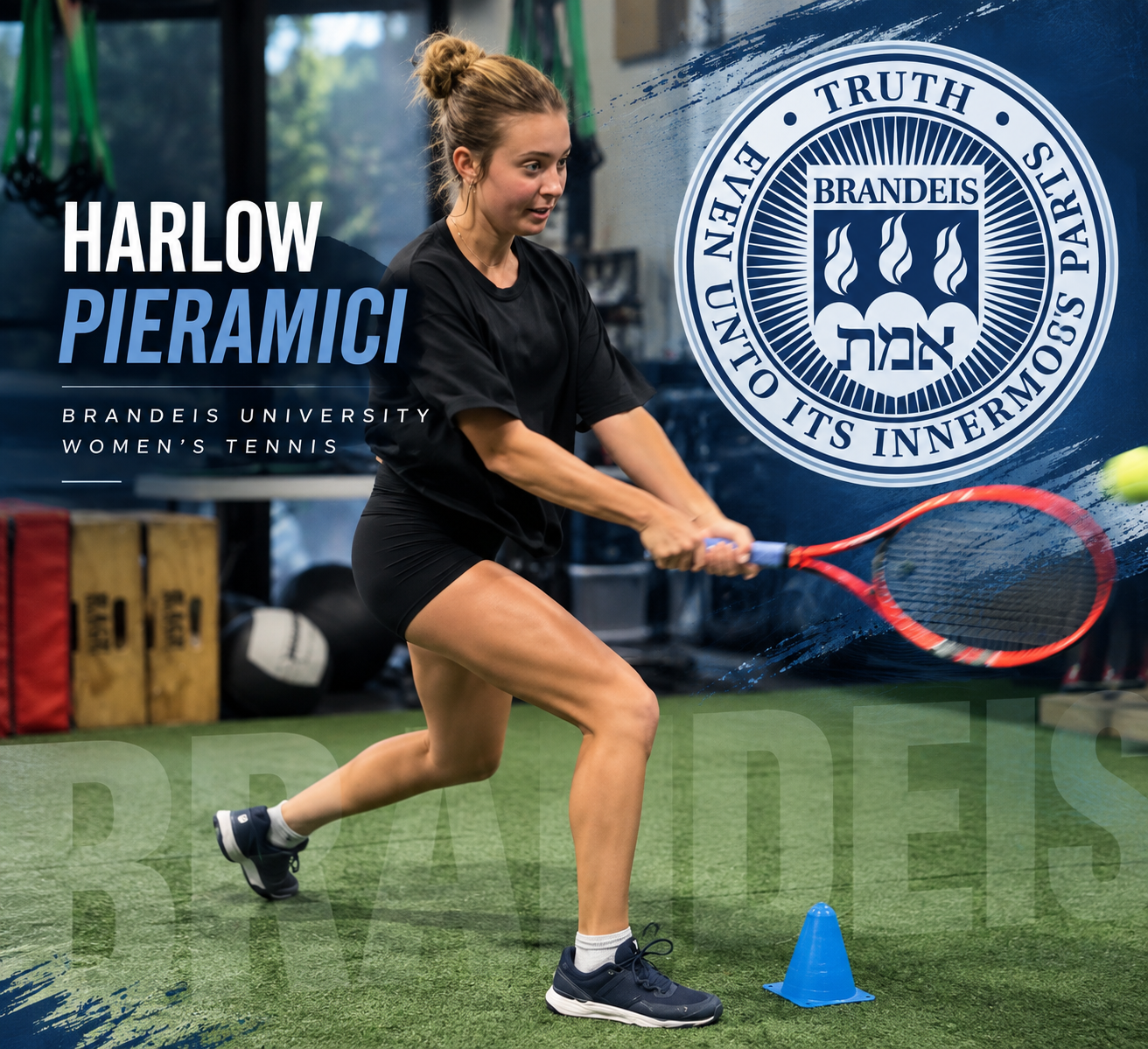
Harlow began training consistently with us at Costa Performance at age 15. Two years later, she continues to be part of our training program and has now committed to play collegiate tennis at Brandeis University.
During her development, her tennis coach, Ivan Puchkarov, identified two physical qualities that could potentially help her game:
Speed and explosiveness.
Rather than simply adding more explosive exercises to her program, we wanted to better understand her physical profile first.
The Question
The initial question was straightforward:
How could we improve Harlow’s ability to produce force quickly and express that capacity through faster, more explosive movement?
This is where assessment becomes useful.
Testing is not about collecting numbers for the sake of having data. The purpose is to identify characteristics that can help us make better training decisions and provide a baseline that can later be reassessed.
What We Measured
We selected tests that could provide information about different components related to Harlow’s physical performance:
Countermovement Jump (CMJ) using VALD ForceDecks
The CMJ allowed us to examine characteristics related to lower-body force production and explosive performance.
10-Meter Sprint using Sports React
Short-distance acceleration is highly relevant to tennis, where athletes frequently need to produce rapid movement over relatively small distances.
Deadlift and Squat Mean Velocity using Output Sports
Monitoring movement velocity during strength exercises gave us additional information about how Harlow expressed force against external resistance.
Importantly, none of these tests is “tennis.”
They don’t need to be.
They help us understand physical qualities that the athlete can potentially use when she returns to the court.
What We Found
The assessment suggested an opportunity to place greater emphasis on the faster end of Harlow’s force-velocity profile.
Based on the testing, coaching observation and feedback from her tennis coach, we adjusted her physical preparation to provide more stimulus in three areas:
Neuromuscular training
Strength-speed
Speed-strength
The goal was not simply to make her stronger.
It was to improve how effectively she could express force at higher velocities.
What Changed in Training
For approximately two months, these qualities received greater emphasis within her off-court strength and conditioning program.
The training still included the broader components required for athletic development, but exercise selection, intent and loading were adjusted to create more opportunities for rapid force production.
This distinction is important.
An athlete can become stronger without necessarily becoming proportionally more explosive.
Strength remains an important foundation, but depending on the athlete’s profile, the next training question may be:
How quickly can that force be expressed?
That became an important part of Harlow’s training during this period.
What Changed?
After two months of consistent application, we reassessed the same variables.
We observed improvements across the measures we had targeted, alongside a noticeable change in Harlow’s explosiveness on court.
The objective data was valuable because it showed that the physical qualities we were targeting were moving in the intended direction.
But the numbers were not the final objective.
The court was.
The most meaningful outcome was seeing those physical changes begin to appear in the environment for which we were preparing her.
What We Learned
This case illustrates an important part of how we approach off-court tennis training at Costa Performance.
We don’t test athletes simply because we have technology available.
And we don’t select exercises simply because they look like tennis.
We start with a question.
We measure what can help us understand that question.
We interpret the results within the context of the athlete.
We adjust training.
Then we reassess.
The process can be summarized simply:
Observe → Measure → Train → Reassess → Return to the Court
It also demonstrates why communication with the tennis coach matters.
Ivan’s observation provided the initial question. Physical testing gave us another layer of information. Strength and conditioning provided the intervention. The court ultimately provided the context in which those changes needed to matter.
For a developing tennis player, this process is also part of something bigger.
Harlow has trained consistently with Costa Performance since she was 15. Her physical preparation has evolved as she has grown, developed and progressed as a tennis player.
Today, as she prepares for the next stage of her career at Brandeis University, the objective remains the same:
Not simply to improve test results, but to use better information to build a more capable athlete.
Cassiano Costa, PhD
Sports Biomechanics & Tennis Performance
Costa Performance | Boca Raton, Florida
See also the link bellow: From Gym to Court: How Strength & Conditioning Transfers to Tennis Performance