
Two tennis players can be the same age, compete at the same level, and still need very different physical preparation strategies.
Imagine two 14-year-old tennis players training at the same academy.
They compete in similar tournaments, practice for approximately the same number of hours, and share the same goal: becoming better tennis players.
However, one athlete has already experienced a significant growth spurt, while the other is still in an earlier stage of physical maturation.
Should they follow exactly the same strength and conditioning program?
Not necessarily.
Chronological age tells us how long an athlete has been alive. It doesn’t tell us everything about their physical development, movement capabilities, or readiness for specific training demands.
Understanding this distinction is an important part of developing young athletes.
At Costa Performance, we believe that effective junior tennis preparation requires more than selecting exercises according to age or competitive ranking.
It requires understanding the individual athlete.
Chronological Age vs. Biological Maturation
Chronological age is simple: a player is 12, 14, or 16 years old.
Biological maturation is more complex.
It describes the progression toward biological maturity, including changes in skeletal development, body composition, hormonal regulation, and physical characteristics.
These processes do not occur at exactly the same time or rate in every adolescent.
Two players of the same chronological age may differ considerably in height, body mass, muscle development, strength, and coordination.
These differences can influence how they perform physical tasks and respond to training.
For example, a player who matures earlier may temporarily demonstrate greater absolute strength, speed, or power than a peer who matures later.
That advantage does not necessarily mean the earlier-maturing player has greater long-term athletic potential.
Similarly, a later-maturing athlete should not be considered less talented simply because their physical development follows a different timeline.
Youth athletic development is not a race to mature first.
It is a process of building physical capabilities over time.
What Happens During a Growth Spurt?
One of the most relevant periods in adolescent development is the growth spurt.
Researchers often describe the period of fastest increase in standing height as Peak Height Velocity, or PHV.
During this phase, an athlete may experience rapid changes in body dimensions and proportions.
Longer limbs, changes in body mass, and alterations in leverage can influence how movements are performed.
A tennis player who previously felt comfortable accelerating, decelerating, or changing direction may temporarily need to adjust to these changing physical characteristics.
Some athletes experience periods of reduced movement consistency during rapid growth.
This is sometimes discussed using the term adolescent awkwardness.
However, this response is not universal. Not every athlete experiences a measurable decline in coordination during puberty.
The important point is that movement should be assessed rather than assumptions made based solely on age or height.
Why Does This Matter in Tennis?
Tennis requires the repeated integration of several physical abilities:
- Acceleration over short distances
- Deceleration and braking
- Lateral movement and changes of direction
- Rotational power
- Dynamic balance and postural control
- Repeated force production under fatigue
During periods of rapid growth, the mechanical demands of these movements can change.
A young player may need additional opportunities to refine movement control, develop strength, and become comfortable with their changing body.
This does not mean avoiding demanding training.
It means selecting and progressing training according to the athlete’s current abilities.
Strength Training During Adolescence: Is It Safe?
A persistent misconception is that strength training is inherently dangerous for children and adolescents or that it interferes with normal growth.
Current scientific consensus does not support that generalization.
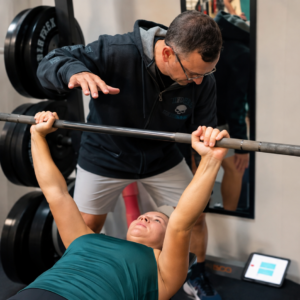
Appropriately designed and supervised resistance training is considered safe and beneficial for young athletes.
Strength training can improve muscular strength, movement competency, and other components of physical fitness.
The key variables are appropriate exercise selection, qualified supervision, technique, progression, and the individual athlete’s training history.
A 13-year-old beginner may benefit from learning basic squatting, hinging, pushing, pulling, landing, and braking patterns.
A more experienced athlete of the same age may be ready for more challenging resistance exercises, depending on technical proficiency and individual characteristics.
The objective is not to make every junior athlete lift heavy weights as early as possible.
It is to progressively develop the ability to produce, absorb, and control force.
These capabilities support the physical demands of tennis.
Training Should Follow Development, Not Just Age
A useful training program considers several dimensions of athlete development.
1. Movement Competency
Can the athlete control fundamental movement patterns?
Can they squat, hinge, land, accelerate, and decelerate with appropriate coordination for the task?
Movement quality is not about forcing every athlete into an identical technique.
It is about developing adaptable movement solutions that allow the athlete to manage different physical demands.
2. Strength Development
Strength provides a foundation for producing and controlling force.
However, the appropriate training stimulus depends on the athlete’s experience, technique, physical development, and current capacity.
Progressive resistance training can be valuable throughout childhood and adolescence when properly supervised.
3. Speed and Power
Speed and power are important in tennis, but they should not be developed through the same training prescription for every player.
Some athletes may benefit from improving basic strength.
Others may need greater emphasis on rapid force production, acceleration mechanics, or the ability to apply force in sport-relevant movement tasks.
4. Training Load and Recovery
Junior tennis players often combine technical practice, physical conditioning, school responsibilities, travel, and competition.
The total workload matters.
During adolescence, changes in growth and training demands may influence how an athlete tolerates repeated loading.
Persistent pain, unusual fatigue, reduced performance, or difficulty recovering should prompt further assessment rather than simply increasing training intensity.
Training load decisions should consider the entire athletic schedule, not just what happens in the gym.
Does Growth Increase Injury Risk?
Periods of rapid growth may be associated with changes in susceptibility to certain musculoskeletal problems, particularly growth-related conditions affecting developing bone and tendon attachment regions.
Examples include some traction apophysitis conditions and other growth-associated overuse problems.
However, injury risk is multifactorial.
It cannot be explained by biological maturation alone.
Training exposure, previous injuries, sport demands, sleep, recovery, individual anatomy, and other factors also contribute.
Therefore, the goal is not to predict injuries from a player’s maturity status.
It is to recognize relevant developmental changes, monitor symptoms, and adjust training when appropriate.
Injury-risk management should be individualized, not based on a single age or growth measurement.
How Can We Assess Junior Tennis Players?
At Costa Performance, physical assessments help us understand the athlete’s current capabilities and identify areas that may benefit from targeted training.
Depending on the athlete and the purpose of the assessment, we may examine:
Jump Performance: Countermovement jump testing can provide information about selected characteristics of lower-body force production and jump performance.
Acceleration: Short sprint assessments help evaluate the athlete’s ability to accelerate over distances relevant to tennis.
Strength and Movement Velocity: Resistance exercises and velocity-based measurements can provide information about strength-related performance and movement speed under selected loads.
Movement Capacity: Observation of mobility, coordination, balance, deceleration, and other relevant tasks helps provide context.
These measurements do not directly determine biological maturity, and no single test provides a complete picture of athletic development.
Their value comes from combining objective information with coaching observations, training history, and the athlete’s individual goals.
From Assessment to Training: A Practical Example
One example of our approach is the development of junior tennis player Harlow Pieramici.
Harlow began training at Costa Performance at age 15 and continued working consistently on her physical preparation.
Her tennis coach, Ivan Puchkarov, identified speed and explosiveness as areas for improvement.
We used countermovement jump testing with VALD ForceDecks, 10-meter sprint testing with Sports React, and movement-velocity measurements with Output Sports to help guide training decisions.
The program placed greater emphasis on neuromuscular training, strength-speed, and speed-strength qualities.
After two months, we observed improvements across the targeted measures, alongside noticeable improvements in explosiveness on court.
Harlow later committed to playing collegiate tennis at Brandeis University.
This example illustrates the value of connecting assessment findings, coaching observations, and individualized training.
It does not mean that every junior athlete should follow the same program or that a particular test result automatically identifies the best training intervention.
Read the full case study: From Assessment to the Court: Developing Speed and Explosiveness in a Junior Tennis Player.
Long-Term Development Matters More Than Short-Term Comparisons
Youth sports can place considerable emphasis on rankings, early results, and comparisons between players.
But physical development is not linear.
An athlete who is physically dominant at 13 may not maintain the same advantage at 18.
A later-maturing player may develop substantial physical capabilities as maturation progresses and training experience accumulates.
This is one reason why long-term athlete development should prioritize progressive skill acquisition, physical literacy, strength, movement adaptability, and sustainable training habits.
The objective is not to identify the strongest 14-year-old.
It is to help each athlete develop the physical foundation needed for the next stages of their athletic career.
What Parents and Coaches Should Remember
When evaluating a junior tennis player’s physical preparation, consider more than chronological age.
Ask whether the training program reflects the athlete’s experience, movement abilities, physical development, competition schedule, and recovery needs.
Young athletes need appropriate challenges, not identical challenges.
And as their bodies change, their training programs should evolve.
At Costa Performance, our approach combines strength and conditioning, biomechanics, performance assessment, and communication with tennis coaches to support the development of competitive athletes.
Because the goal is not simply to train the young tennis player you see today.
It’s to prepare the athlete they are becoming.
Junior Tennis Strength & Conditioning in Boca Raton
Costa Performance provides individualized physical preparation for junior, collegiate, and professional tennis players.
Our training focuses on developing strength, speed, power, movement capacity, and the physical qualities required for competitive tennis.
Contact Costa Performance to learn more about our junior tennis performance programs in Boca Raton, South Florida.
Cassiano Costa, PhD
Sports Biomechanics & Tennis Performance
Costa Performance | Boca Raton, Florida
Lloyd RS et al. (2014). Position statement on youth resistance training: the 2014 International Consensus. British Journal of Sports Medicine. DOI: 10.1136/bjsports-2013-092952.
Bergeron MF et al. (2015). International Olympic Committee consensus statement on youth athletic development. British Journal of Sports Medicine. DOI: 10.1136/bjsports-2015-094962.
Malina RM et al. (2015). Biological maturation of youth athletes: assessment and implications. British Journal of Sports Medicine. DOI: 10.1136/bjsports-2015-094623.
See Also: