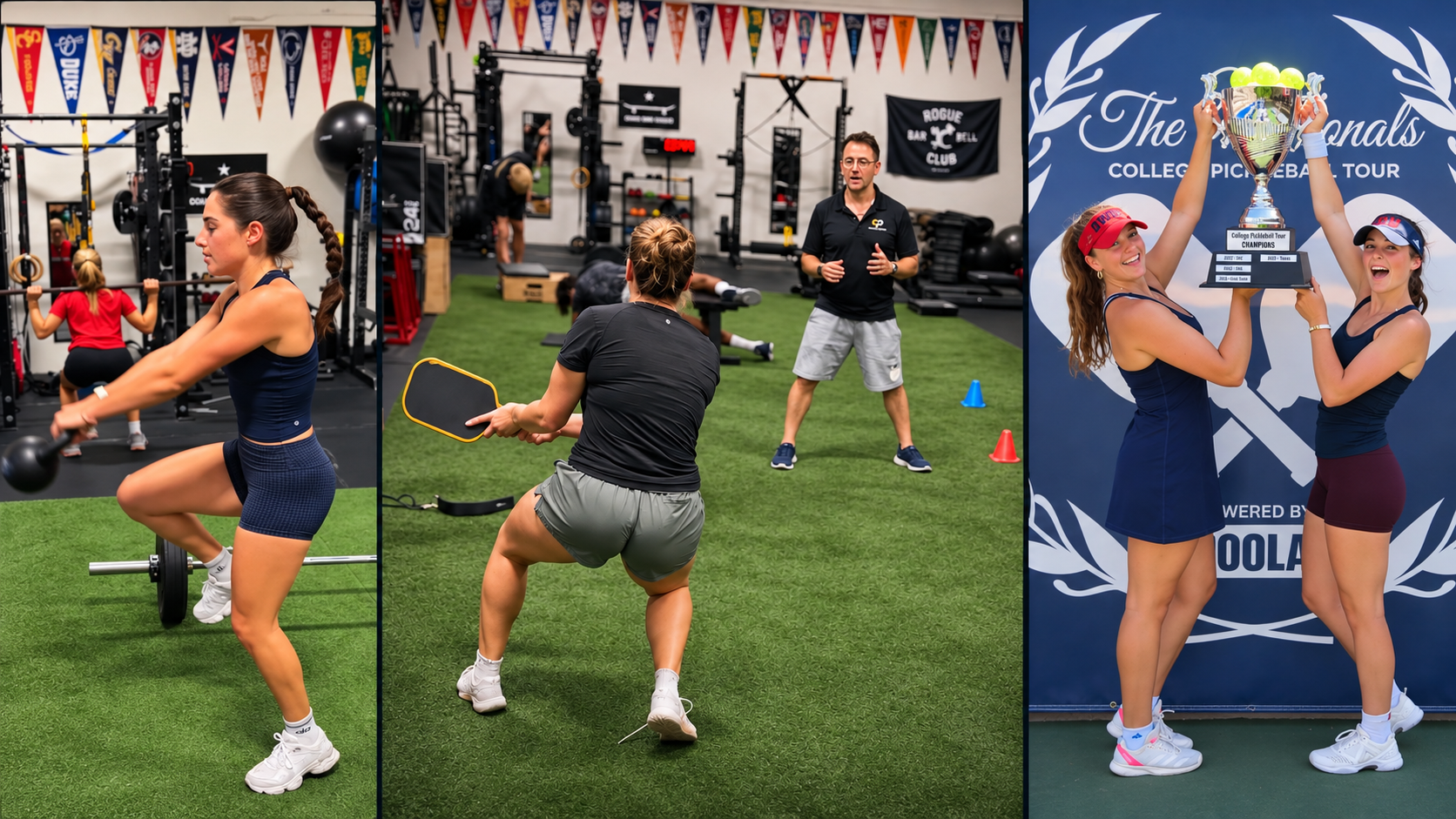
Understanding the physical demands of pickleball and how strength and conditioning can support better movement, performance, and long-term athletic development.
Pickleball is often described as an accessible sport. The court is smaller than a tennis court, the paddle is relatively light, and players of different ages and experience levels can enjoy the game.
But accessible doesn’t necessarily mean physically undemanding.
Watch a competitive pickleball match closely, and you’ll see players accelerating over short distances, stopping abruptly, changing direction, reacting to fast exchanges, and repeatedly adjusting their body position.
The movements may be smaller than those seen in other racket sports, but they still require considerable physical control.
And as the sport becomes faster and more competitive, physical preparation becomes increasingly relevant.
At Costa Performance in Boca Raton, Florida, we approach pickleball strength and conditioning by examining the physical capabilities that support these demands.
Rather than simply reproducing pickleball movements in the gym, we focus on developing the athlete’s ability to produce, absorb, and control force while responding to changing situations.
1. A Smaller Court Doesn’t Eliminate Physical Demands
Pickleball is played on a court measuring 20 by 44 feet, considerably smaller than a standard tennis court.
However, the smaller playing area creates its own movement demands.
Players frequently perform short accelerations, lateral adjustments, split steps, forward movements, and rapid changes in body position.
During exchanges near the non-volley zone, or kitchen, the ability to maintain balance and reposition efficiently becomes particularly important.
A player may need to move forward to reach a short ball, control their momentum, and immediately prepare for the next shot.
These situations require a combination of physical qualities, including lower-body strength, coordination, balance, and braking capacity.
The objective of physical preparation is to help players develop the capacity to manage these repeated demands.
2. Deceleration: The Overlooked Part of Quick Movement
When people think about speed, they usually imagine how quickly an athlete can accelerate.
But in pickleball, the ability to slow down is just as important.
Imagine moving forward to reach a drop shot.
Getting to the ball quickly matters, but arriving with excessive momentum may make it difficult to maintain balance and prepare for the next exchange.
Deceleration involves reducing movement velocity by producing forces that oppose the direction of motion.
This process depends on several factors, including strength, coordination, movement strategy, and the ability to manage loading.
In the gym, exercises such as controlled landings, unilateral strength movements, eccentric loading, and progressive change-of-direction drills can help develop relevant physical capacities.
However, there is no single exercise that automatically improves every aspect of deceleration.
Training should progress according to the athlete’s abilities, experience, and physical demands.
In pickleball, moving quickly is valuable. Being able to control that movement is equally important.
3. Strength Is Not Just About Hitting Harder
Strength training is sometimes misunderstood as something primarily intended to increase muscle size or hitting power.
For pickleball players, its relevance is much broader.
Lower-body strength contributes to the ability to produce and manage forces during acceleration, stopping, and changes of direction.
Trunk and upper-body strength support the physical demands of repeated movements and paddle actions.
Unilateral strength is particularly relevant because many sporting movements involve asymmetrical positions and loading.
Exercises such as split squats, lunges, step-ups, and other progressive resistance-training methods can help develop strength in positions that may be useful for athletic preparation.
But the choice of exercise should depend on the individual.
A recreational player beginning resistance training may need a different program from an experienced competitive athlete.
The goal is not to make every pickleball player lift heavier weights. It is to develop the strength appropriate to their needs.
4. Reaction, Tracking, and Decision-Making
Pickleball involves rapid exchanges, particularly near the kitchen.
Players must track the ball, interpret an opponent’s actions, anticipate possible outcomes, and select an appropriate response.
These processes involve visual information, perception, attention, decision-making, and motor coordination.
Although reaction time is often discussed as a single ability, successful responses in sport depend on much more than how quickly someone reacts to a simple stimulus.
Experienced players can use contextual information and anticipation to prepare their movements before the ball reaches them.
In the gym, we can introduce exercises that challenge reaction, tracking, balance, coordination, and movement adaptation.
For example, a player may need to respond to an unpredictable visual cue while maintaining control of their body position.
These activities can create useful movement challenges and complement physical preparation.
However, they should not be confused with a replacement for actual pickleball practice.
Sport-specific anticipation and decision-making are developed primarily through meaningful practice within the sport.
Our role in strength and conditioning is to develop supporting physical capacities and provide appropriate coordination and response challenges.
5. Balance and Movement Control Under Pressure
Balance is not simply the ability to stand on one leg.
In sport, balance involves controlling the body’s position while interacting with changing movement demands.
A pickleball player may need to reach laterally, recover from a forward movement, or stabilize after an unexpected adjustment.
These situations require coordination between sensory information, muscular force production, and movement control.
Training may include unilateral exercises, multidirectional movements, progressive landing tasks, and balance challenges.
The objective is not necessarily to make every exercise unstable or difficult.
In fact, stable exercises often provide an excellent environment for developing strength.
More challenging balance tasks can then be introduced when they serve a specific training objective.
Effective training is not about making exercises look complicated. It is about selecting the right challenge for the athlete.
6. Conditioning and the Ability to Repeat Efforts
Pickleball matches involve repeated periods of activity separated by pauses.
The intensity and duration of these efforts vary with playing style, skill level, match format, and competitive demands.
Although many movements are brief, players may need to maintain physical and cognitive performance throughout prolonged playing sessions or multiple matches.
Aerobic fitness contributes to the ability to sustain activity and recover between repeated efforts.
Higher-intensity conditioning may also be relevant, depending on the player’s competitive needs.
However, conditioning should not be limited to exhausting interval sessions.
A well-designed program considers the athlete’s current fitness, weekly playing volume, recovery, and other physical activities.
The goal is to develop appropriate capacity without unnecessarily increasing fatigue.
7. Physical Preparation and Injury-Risk Management
As pickleball participation grows, so does the importance of understanding the physical demands placed on players.
The sport involves repeated loading of the lower extremities, trunk, shoulders, elbows, and wrists.
Training history, physical capacity, previous injuries, recovery, and overall exposure can all influence how an individual responds to these demands.
Strength and conditioning can contribute to developing physical capacity and tolerance to progressive loading.
However, no training program can guarantee injury prevention.
For players returning after an injury, physical preparation should be coordinated with the recommendations of their licensed healthcare professionals.
The objective is to support appropriate progression and help athletes manage the demands of participation.
8. Why Individual Assessment Matters
Two pickleball players of the same age may have very different physical characteristics.
One may have a background in competitive tennis and extensive resistance-training experience.
Another may have discovered pickleball later in life and be starting a structured physical training program for the first time.
Their needs should not be assumed to be identical.
At Costa Performance, we combine coaching observations, training history, and objective performance assessments to better understand individual physical capabilities.
Our assessment technologies include VALD ForceDecks, Kinvent force plate systems, and Output Sports, which can provide selected information about force production, jump performance, movement velocity, and other physical variables.
These measurements help inform training decisions and monitor changes over time.
They do not replace professional judgment, and no single test provides a complete picture of athletic performance.
Assess. Train. Reassess. Adapt.
9. Training for Pickleball at Costa Performance
At Costa Performance, we believe effective sports performance training begins with understanding the athlete.
Whether someone is a recreational pickleball player seeking to improve their physical fitness or a competitive athlete preparing for demanding matches, training should reflect their individual needs.
Our approach combines strength and conditioning, movement development, performance assessment, and progressive training methods.
We focus on physical preparation that complements technical practice rather than attempting to replace it.
For pickleball players, this may include developing strength, power, acceleration, deceleration, balance, coordination, and conditioning.
The specific priorities depend on the athlete.
There is no perfect exercise for every pickleball player, and there is no single program that fits every level of experience.
Better decisions lead to more purposeful training.
Build the Physical Capacity Behind Your Game
Pickleball is a sport of movement, anticipation, precision, and repeated physical demands.
Developing strength, control, and conditioning can help players build the physical foundation needed to meet those demands.
At Costa Performance in Boca Raton, Florida, our goal is to help athletes understand and develop their physical capabilities through individualized, evidence-informed training.
Train with purpose. Move with control. Keep improving.
[EXPLORE SPORTS PERFORMANCE TRAINING AT COSTA PERFORMANCE]
Costa Performance | Boca Raton, Florida
Strength & Conditioning | Sports Biomechanics | Performance Assessments | Athletic Development